
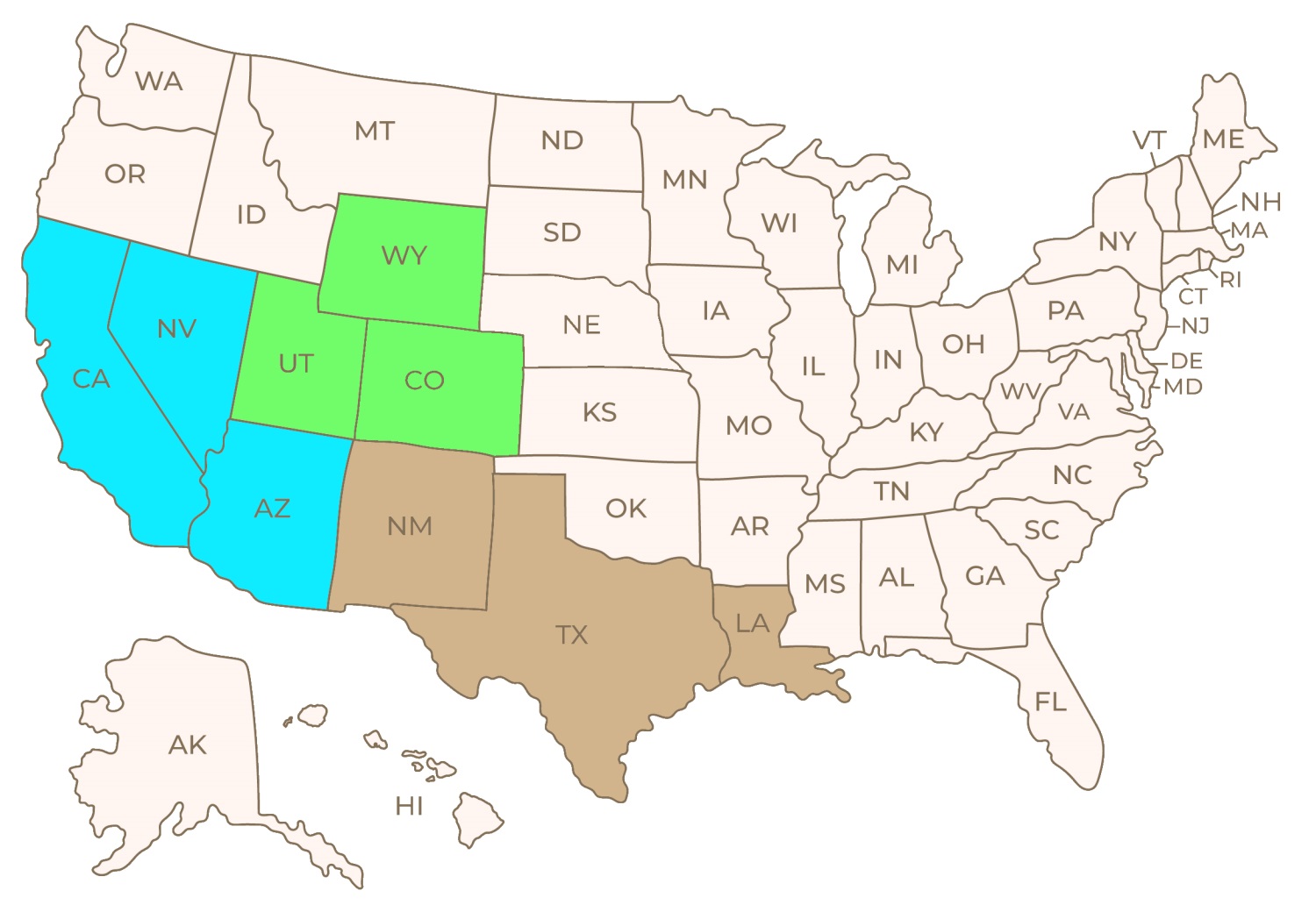
All campuses currently being invited to serve as a TUEE Collaboratory lead university are major, large universities that currently do not have the capacity to do so. However, by completing a basic regime of the start-up phase prior to Mid-August 2024, The University should achieve more than ample human capacity with financial contributions exceeding $800K from SCPs and their alums by the end of October 2024.
All invited universities are located in three regions: Pacific Southwest (AZ, CA NV), Rocky Mountain (CO, ID, UT) or Gulf Southwest (LA, NM, TX). It is suggested that at the beginning of the Start-Up Phase, each lead university candidate would ideally establish one founding Strategic Corporate Partner (SCP) by early June then a total of four SCPs by mid-August. The founding SCPs would be major companies with headquarters or large local operations with an average of at least four hundred practicing professional alums including recent retirees (These data may be sourced from alumni registered with LinkedIn.) By the inaugural Day on Campus with Strategic Corporate Partners event in November 2024, founding SCPs should scale to 8-10 members, from the four SCPs established by mid-August.
This large alumni pool represents an immediately identifiable source of significant potential financial resources (including corporate matching) to The University for sustainable early-stage funding of this initiative (also see the Strategic Corporate Partner Investment Guidelines at www.curg.net). However, most importantly, such a huge human resource pool would support and complement campus administrators, faculty, and staff. This available cohort of practicing professionals would engage with students as coaches and mentors in a wide variety of projects and professional development activities throughout the undergraduate experience. As the number of SCPs is scaled after June 2026, it would increase to many companies/organizations of various types and sizes over the years, until it comes to represent the entire ecosystem of the university. This newly added process becomes an increasingly important source of additional financial and human resources for improving and scaling existing programs and the development of new sustainable programs into the future. The goal of such growth is that each student would be fully prepared with all required skill sets to enter their chosen career fields and excel in initial professional workplaces as practicing engineers and computer scientists.